
Few ingredients are as widely recognised, and as widely misrepresented, as wasabi. The vivid green paste served beside sushi worldwide is overwhelmingly an imitation built on horseradish, mustard and food colouring; authentic wasabi, the freshly grated rhizome of Eutrema japonicum, remains a rarity even in Japan. Its scarcity is not marketing: the plant is one of the most demanding crops in the world to grow, and its signature aromatic compounds begin to fade minutes after grating.
The Cruciferous Vegetables article covers the shared chemistry of glucosinolates, the Nrf2/NF-κB mechanisms, and the broader evidence for cruciferous intake, this article narrows the lens to wasabi specifically, its botanical identity, the structural gap between real and substitute products, the cultivation systems that make genuine rhizomes so scarce, its verified nutrient profile, the distinctive bioactive 6-MSITC, the state of clinical evidence, practical culinary applications, and known precautions.
1. Botanical Profile
Wasabi belongs to the Brassicaceae family, placing it among the same botanical lineage as broccoli, cabbage, mustard and horseradish. Its currently accepted scientific name is Eutrema japonicum (Miq.) Koidz., with Wasabia japonica now treated as a synonym. The plant is a perennial native to Japan, the Russian Far East (including Sakhalin), and the Korean Peninsula, where it grows naturally along the beds of cool mountain streams.
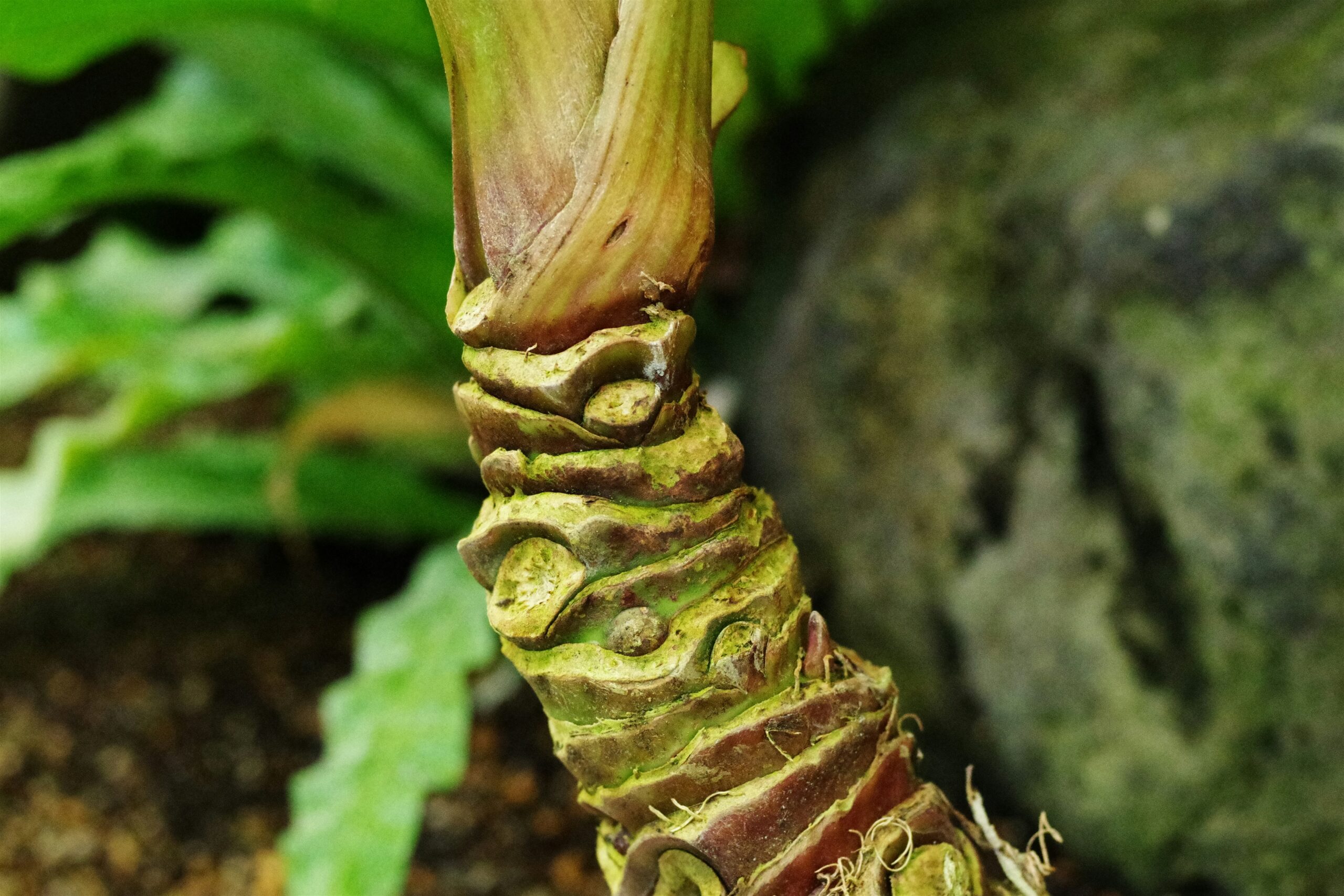
A common misconception is that wasabi is a root. It is in fact a rhizome, a thickened, horizontally growing underground stem, from which leaves, petioles and true roots emerge. Mature plants typically reach 30-60 cm in height and produce large, heart-shaped leaves and four-petalled white flowers, the cross-shaped bloom that historically gave the Brassicaceae their earlier name, Cruciferae.
Although numerous named cultivars exist, the two dominant varieties in commercial cultivation are E. japonicum ‘Daruma’ and ‘Mazuma’, selected for rhizome size, heat profile and aroma. The oldest written record of wasabi as food dates to the 8th century, appearing in Fuyaku ryō tax documents from 718 CE; by the Heian and Muromachi periods it was already established as a medicinal and culinary ingredient at the Japanese court.
2. Real Wasabi vs. Substitute Products
The gap between authentic wasabi and what most consumers call “wasabi” is the single most important context for reading any label. Widely cited industry and media estimates suggest that the vast majority of commercially served wasabi is imitation, especially outside Japan, with figures often reported above 90%. Robust audited market data are limited, so these numbers should be read as directional rather than precise, but the underlying pattern is consistent across producer associations, specialist retailers and industry reporting.
What substitute wasabi actually contains. Most tubes, sachets and powdered products sold as wasabi are built on European horseradish (Armoracia rusticana), mustard powder, starch and green food colouring, often with only 1-3% of real wasabi, or none at all. In Japan, horseradish is explicitly referred to as seiyō-wasabi (“Western wasabi”) or wasabi-daikon, while authentic Eutrema japonicum is sold as hon-wasabi (“true wasabi”).
Labelling standards. The Japan Processed Wasabi Association defines two regulated label claims for processed products: “hon-wasabi shiyō” requires at least 50% real wasabi, while “hon-wasabi iri” indicates less than 50%. Outside Japan, equivalent statutory protection is rare, so checking ingredient lists for Wasabia japonica or Eutrema japonicum, and their position in the list, remains the most reliable signal of authenticity.
How to tell the difference on the plate. Freshly grated real wasabi is a muted, slightly grainy pale green with a clean, floral-sweet aroma and a heat that rises quickly into the nose and fades within minutes. Imitations tend to be a uniformly bright green, smoother in texture, with a longer, harsher burn carried over from horseradish and mustard.
3. Production, Cultivation and Market
Wasabi is widely regarded as one of the most cultivation-sensitive high-value culinary crops in commercial agriculture. The plant tolerates only a narrow temperature band, roughly 8-20°C, demands dense shade and very high humidity, and is intolerant of direct sunlight. Rhizomes take 18 to 24 months (and in higher-end operations up to three years) to reach market size, during which small deviations in water quality, temperature or shade can destroy an entire crop.
Two cultivation systems. Japanese producers distinguish between sawa wasabi (水山葵, water-grown) and hata wasabi (畑山葵, field-grown, also oka). Sawa cultivation uses terraced beds irrigated by constantly flowing spring water, producing the thick rhizomes destined for premium fresh grating. Hata wasabi is grown in soil-based systems under shade and is more often directed toward processed products, where leaves and petioles are also used.
Geographical concentration. Japanese wasabi production is dominated by Shizuoka and Nagano prefectures, which together account for over 90% of national sawa output, while Iwate produces roughly 60% of field wasabi. In 2018, Traditional Wasabi Cultivation in Shizuoka was designated a Globally Important Agricultural Heritage System by the FAO, recognising both the terraced tatamiishi method, in use since 1892, and the surrounding conservation of spring water and forest canopy.
International production and price. Commercial operations now exist outside Japan, including in the United Kingdom, New Zealand, Canada, the United States and Australia. Independent growers report farm-gate prices of around USD 220 per kilogram (approximately €195/kg) in North America, while UK specialist The Wasabi Company lists retail at around £250/kg (≈ €290/kg (≈ €330/kg USD equivalent)). Historic BBC reporting cited wholesale prices of USD 160/kg and retail peaks of USD 308/kg. Across sources, a working range of €90-€290 per kilogram (≈ US$100–US$330/kg) captures most documented transactions, placing authentic wasabi among the more expensive culinary crops sold by weight.
4. Nutritional Composition
Because wasabi is consumed in very small quantities, typically 1-5 grams per serving, its contribution to daily macronutrient intake is negligible. At the level of the rhizome itself, however, it is a nutrient-dense cruciferous rhizome, notably rich in vitamin C and dietary fibre for a plant of its type. Values below are drawn from USDA FoodData for Wasabi raw, and for context also Horseradish raw :
Nutrition Explorer
Source: USDA FoodData Central · Values per 100 g · % DV based on FDA 2,000 kcal/day reference · 0 values may indicate unmeasured, not absent
At a typical serving size (around 2 g of freshly grated rhizome per sushi piece), absolute nutrient contribution is minimal. The relevance of wasabi is therefore primarily bioactive rather than nutritional, which places the focus on its isothiocyanate profile.
5. Bioactive Compounds
The general glucosinolate-myrosinase-isothiocyanate pathway is covered in the Cruciferous Vegetables article. This section focuses on the specific compounds that distinguish wasabi from its cruciferous relatives.
5.1 6-Methylsulfinylhexyl Isothiocyanate (6-MSITC)
6-MSITC, also known as hexaraphane, is the signature isothiocyanate of the wasabi rhizome. Structurally it is a sulphur-bridged ITC distinct from the sulforaphane of broccoli: both activate the Nrf2/Keap1-ARE antioxidant response element pathway, but 6-MSITC also modulates several additional signalling cascades, including PPAR, AMPK, PI3K/AKT/mTOR and ERK1/2, which is why it is being investigated separately from the better-known sulforaphane. A 2024 review in Nutrients catalogued these mechanisms across in vitro and animal studies, noting anti-inflammatory, anti-atherosclerotic, neuroprotective and anti-obesity effects alongside a low toxicity profile in available safety data.
5.2 Allyl Isothiocyanate (AITC)
AITC is the second major pungency-linked ITC in wasabi, shared with horseradish and mustard, and the primary driver of the volatile, sinus-clearing heat. Chemical analysis in a Frontiers in Microbiology study identified AITC as the dominant isothiocyanate in raw wasabi on a weight basis and demonstrated bactericidal activity against Escherichia coli O157:H7 and Staphylococcus aureus at low micromolar concentrations. Other in vitro work has reported strong bactericidal activity against Helicobacter pylori, the bacterium associated with gastric ulcers, across both the rhizome and the leaves. Related pungent ITCs reported in the rhizome include 3-butenyl and phenethyl isothiocyanates.
5.3 Why the pungency fades
Isothiocyanates in wasabi are highly volatile. Once the rhizome cell walls are ruptured by grating, myrosinase cleaves intact glucosinolates into ITCs, and those ITCs then begin to evaporate and degrade. The characteristic aroma and heat of freshly grated wasabi peak within the first few minutes and decay substantially over 15-20 minutes, which is the reason Japanese chefs grate authentic wasabi immediately before serving, traditionally on a oroshigane sharkskin grater.
6. What the Clinical Evidence Shows
The human evidence base on wasabi is considerably smaller than that for broccoli or kale. Most studies have been conducted in Japan, often with standardised 6-MSITC-containing extracts; the absolute number of participants remains small, and independent replication outside Japan is still limited. The findings below should therefore be read as emerging rather than settled.
6.1 Cognitive Function and Memory
In a 2023 double-blind randomised controlled trial in Nutrients, 72 healthy adults aged 60 and over received either 0.8% 6-MSITC extract (0.8 mg/day) or placebo for 12 weeks, in a single-centre study with a modest sample size. The 6-MSITC group showed statistically significant improvements in episodic and working memory tasks relative to placebo, with no serious adverse events. Earlier trials by the same research group reported comparable effects on memory, attention and judgement in middle-aged adults.
6.2 Fatigue and Sleep
A 2023 open-label study in BioPsychoSocial Medicine gave 20 healthy volunteers experiencing daily fatigue a wasabi-derived powder providing 4.8 mg/day of 6-MSITC for four weeks. Baseline fatigue, subjective sleep quality and mood improved significantly, although post-mental-task fatigue did not. A parallel overdose arm tested doses up to 16 mg/day for four weeks with no significant safety signals. The single-arm design limits the strength of the efficacy conclusions, but the safety data are informative.
6.3 Myalgic Encephalomyelitis / Chronic Fatigue Syndrome
A 2022 open-label trial by Oka et al. in BioPsychoSocial Medicine administered 9.6 mg/day of 6-MSITC for 12 weeks to 15 patients with ME/CFS. Self-reported performance status, cognitive task performance and pain threshold measures improved from baseline. The absence of a placebo arm and the small sample preclude firm conclusions; the results may justify further placebo-controlled trials rather than stand as evidence of efficacy.
6.4 Antimicrobial Activity
Beyond the Frontiers in Microbiology data cited above, in vitro studies have reported activity of wasabi-derived ITCs against Helicobacter pylori and Campylobacter jejuni. These findings have led to the hypothesis that wasabi’s antimicrobial compounds may have complemented its traditional culinary use with raw fish, though historical pairings likely reflect multiple factors beyond food safety alone. The ITC concentrations delivered by a typical culinary portion are also far below the bactericidal thresholds used in laboratory settings.
6.5 Other areas under investigation
Preclinical work summarised in the 2024 Nutrients review has examined 6-MSITC in models of breast, colorectal and gastric cancer, obesity, metabolic syndrome, Alzheimer’s and Parkinson’s disease. These findings come from in vitro and animal studies, direct human clinical trials in these indications have not yet been completed, and should not be read as evidence of therapeutic efficacy in people.
7. Culinary Applications
In traditional Japanese cuisine, authentic wasabi is grated on oroshigane immediately before service and used as a condiment for sushi, sashimi, soba and udon, and ochazuke. Fine-dining practice often places the grated paste between rice and fish rather than mixing it into soy sauce, a practice considered to flatten both flavours.
Beyond the rhizome itself, all major above-ground and rhizome tissues of the plant are edible. Wasabi leaves, petioles and flowers are used fresh in salads, lightly pickled, or preserved in sake lees as wasabizuke, a specialty of Shizuoka. Contemporary kitchens also pair wasabi with steak, potatoes, mayonnaise-based dressings and cocktails, where the volatile heat adds a clean top note without lingering burn.
Practical technique. Given the rapid decay of its volatile ITCs, freshly grated wasabi should be used within roughly 15 minutes; after that, most of its aromatic character is lost even though the paste remains visually unchanged. Reconstituted powders and tubes behave differently, their pungency comes mostly from AITC derived from horseradish and mustard, which is more stable but also lacks the floral complexity of the fresh rhizome.
8. Precautions and Contraindications
Wasabi is generally recognised as safe at culinary quantities. At higher doses, whether from very large fresh portions or concentrated supplements, a few considerations apply.
- Gastrointestinal sensitivity. Concentrated isothiocyanates can irritate gastric and intestinal mucosa. Individuals with peptic ulcers, GERD or inflammatory bowel disease may wish to avoid large portions or concentrated extracts.
- Anticoagulant interactions. In vitro work suggests that ITCs may inhibit platelet aggregation. People on anticoagulant or antiplatelet therapy should consult a healthcare professional before using wasabi supplements.
- Allergy. Cross-reactivity within the Brassicaceae family is uncommon but documented; people with known allergies to mustard or horseradish should introduce wasabi cautiously.
- Thyroid function. Like other Brassicaceae, wasabi contains goitrogenic compounds that can, in principle, interfere with iodine uptake at high chronic intakes. At ordinary culinary quantities (1-5 g per serving), this is not a practical concern for the general population; the relevant caveat is primarily for those relying on concentrated wasabi-derived supplements.
- Supplement framing. The clinical trials cited above used standardised 6-MSITC extracts at specific doses (typically 0.8-9.6 mg/day). Doses of isolated 6-MSITC extracts are not interchangeable with culinary wasabi servings, and the two should not be conflated.
9. Conclusion
Authentic wasabi occupies an unusual position within the cruciferous family: culturally iconic, commercially scarce, and biochemically distinct. Its signature compound, 6-MSITC, extends the broader cruciferous isothiocyanate story with its own molecular fingerprint and a growing, if still preliminary, human evidence base.
Horseradish-based ‘wasabi’, meanwhile, is a legitimate condiment in its own right, reliable, shelf-stable, and responsible for most of the heat associated with sushi worldwide. What matters for the reader, cook or buyer is simply knowing which is which, because the two products deliver different flavours, different chemistries and different price points, and recognising that difference is what makes an informed choice possible.
─────────────────────────────
This article is part of Bem Bloom’s Cruciferous Vegetables series. All information is provided for informational purposes only. It is not a substitute for professional medical or nutritional advice. Consult a qualified healthcare professional before making significant changes to your diet.
References and Further Reading
- Bartkowiak-Wieczorek et al. (Nutrients, 2024): 6-MSITC from wasabi: review of cancer, neurodegenerative and metabolic applications
- Nouchi et al. (Nutrients, 2023): double-blind RCT on wasabi 6-MSITC and memory in adults aged 60+
- Nakajima et al. (BioPsychoSocial Medicine, 2023): 6-MSITC on fatigue, sleep and safety in healthy volunteers
- Oka et al. (BioPsychoSocial Medicine, 2022): wasabi extract containing 6-MSITC in ME/CFS: open-label trial
- Lu et al. (Frontiers in Microbiology, 2016): antibacterial activity of wasabi and AITC against E. coli O157:H7 and S. aureus
- Britannica: Wasabi (Eutrema japonicum): plant, cultivation and uses
- JETRO: Highlighted Japanese Ingredients: Wasabi
- FAO: Traditional WASABI Cultivation in Shizuoka (Globally Important Agricultural Heritage System, 2018)
- Government of Japan: Wasabi cultivated in clear-flowing water (Shizuoka, tatami-ishi style)
- McGill University OSS: Wasabi and health: more than heat in sushi