
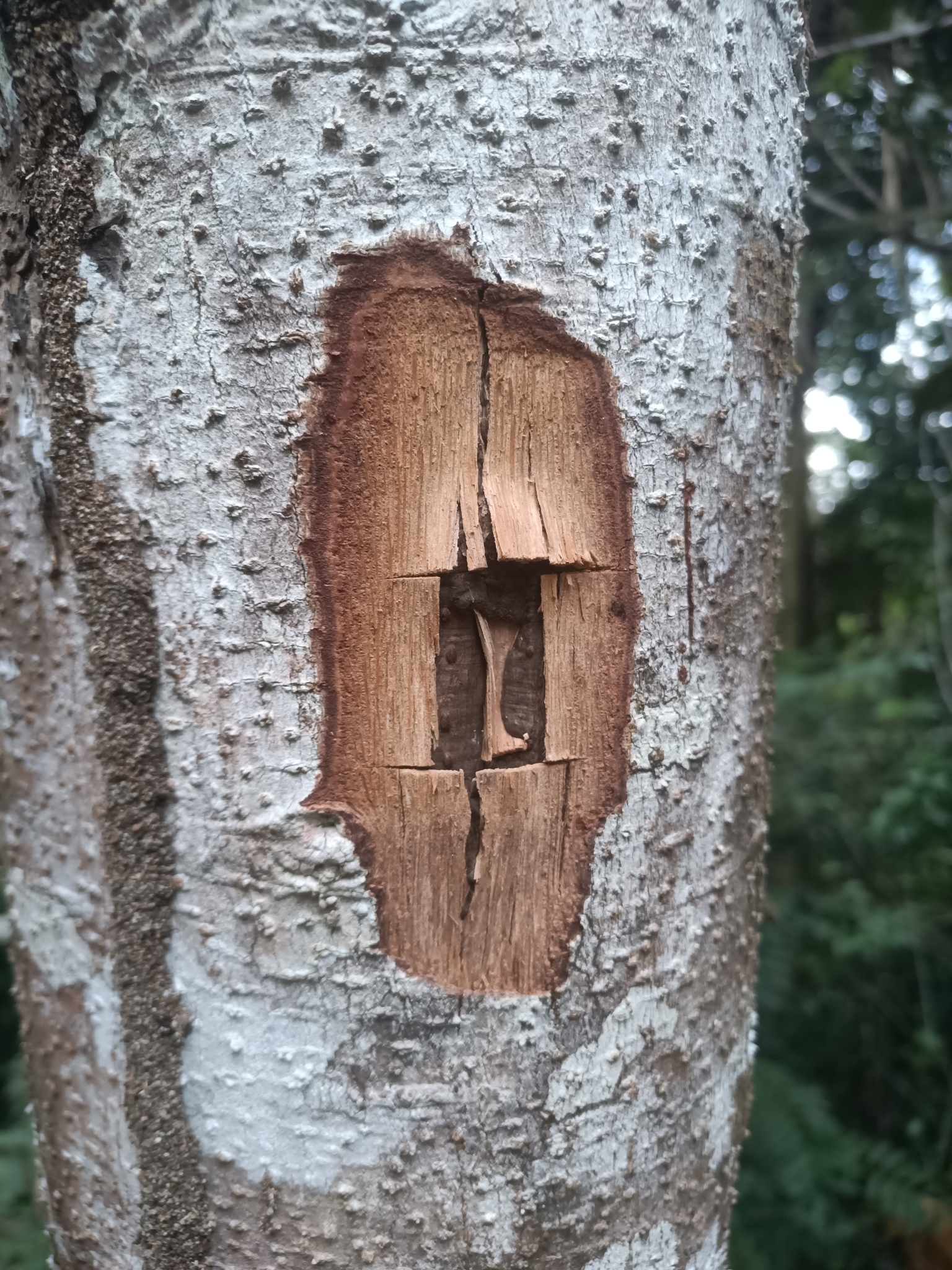
The image the phrase “endangered species” conjures is almost always an animal with a face. But the IUCN Red List does not stop at fauna, and neither should we. For the first time, the subject of a Bem Bloom’s Endangered Species article is a plant: a towering Amazonian tree whose fragrant heartwood was so valuable that the species was logged toward collapse to extract a few litres of scented oil from each trunk.
The tree is Aniba rosaeodora, known in English as Brazilian Rosewood and in Portuguese as Pau-Rosa. It can reach 30 metres in height and two metres in diameter, and the whole tree is aromatic. That fragrance is also its misfortune: distilled, the wood yields rosewood oil, one of the most prized natural sources of linalool in the history of perfumery. For more than a century, the standard way to obtain that oil was to cut the tree down.
A Different Kind of Endangered Species
It is worth pausing on why a tree belongs in a series otherwise populated by mammals and reptiles. The IUCN Red List assesses the extinction risk of plants, fungi and animals alike, using the same categories: Vulnerable, Endangered, Critically Endangered, and so on. Yet plants are dramatically under-represented in public attention relative to their share of threatened life. Of the roughly 1.9 million species described by science, only a fraction have been formally assessed, and plants make up a large and disproportionately threatened portion of those that have.
Plants also tend to become endangered in a quieter way than animals. There is no poaching scandal, no charismatic individual to name and track. A tree species can be hollowed out of an entire region over decades of selective logging while the forest around it still looks intact. Aniba rosaeodora is a textbook case: it was extracted, region by region, until the commercially accessible trees were simply gone. Recognising flora as endangered species, not just the backdrop against which animals live, is part of seeing the biodiversity crisis whole.
A tree is also a hub in a web of other species, which is part of why losing one matters beyond the tree itself. Rosewood grows in old-growth highland forest, scattered rather than clumped, in loose groups of a handful of trees set hundreds of metres apart. Its small flowers are pollinated mainly by native stingless bees, and its purple, single-seeded fruit feeds toucans and parrots, which in turn disperse the seeds (although parrots also destroy a great many fruits before they ripen). Flowering and fruiting are irregular from year to year in the wild, an apparent strategy to outpace those seed predators. Strip such a tree out of the canopy and a set of finely tuned relationships goes with it.
| Common names | Brazilian rosewood, rosewood tree; pau-rosa (Portuguese); bois de rose (French) |
| Scientific name | Aniba rosaeodora Ducke (family Lauraceae) |
| IUCN status | Endangered (assessed 2021) |
| CITES listing | Appendix II, in force since 23 June 2010 |
| Native range | Amazon basin: Brazil (Amazonas, Pará, Amapá), plus Colombia, Ecuador, Guyana, Peru, Suriname, Venezuela; considered locally extinct in French Guiana |
| Size | Evergreen tree up to ~30 m tall and 2 m in trunk diameter |
| Key compound | Linalool – a fragrant monoterpene alcohol, the dominant constituent of rosewood oil |
| Primary threat | Destructive harvesting for essential oil, compounded by Amazon deforestation and slow regeneration |
A Tree Distilled into Perfume
The story of this tree’s decline is, to an unusual degree, the story of a single product. Aniba rosaeodora was exploited above all for its linalool-rich essential oil, used as a fragrance ingredient and as a fixative (a component that slows evaporation and makes a scent last) in fine perfumery. Linalool is also a chemical building block for other valuable fragrance compounds, which made the oil doubly attractive to the industry.
Crucially, the oil came from the wood, not from a renewable part of the plant. The conventional method has barely changed in a century: the tree is felled, cut into roughly one-metre logs, floated downriver to a distillery, chipped, and steam-distilled. Each tree yields only about one percent of its wood weight as oil. In other words, the species was not a casualty of agriculture clearing its habitat for something else, the tree itself was the raw material, and harvesting it meant destroying it. Analyses of the oil routinely find linalool making up the large majority of its content, often around 80 percent and in some samples above 90 percent, which is precisely what gave rosewood its reputation in the first place.
One point of confusion is worth clearing up, because it trips up almost everyone. This “Brazilian rosewood” is not the rosewood prized by guitar and piano makers. That tonewood is Dalbergia nigra, listed on the stricter CITES Appendix I. Aniba rosaeodora belongs to the laurel family (Lauraceae) and is valued for its scent, not its grain. The two trees share a common name and a conservation predicament, but nothing else, a luthier and a perfumer are talking about entirely different species when they say “rosewood.”
The Arithmetic of Extraction
Because rosewood oil was distilled from solid timber, the numbers behind it are sobering. Brazil’s own assessment, submitted when it proposed the species for CITES protection, laid out the scale of what a century of harvesting cost the forest.
| The cost of rosewood oil | Estimate |
|---|---|
| Timber needed to fill one 180 kg drum of oil | 18-20 tonnes |
| Oil yield per weight of trunk | 0.7-1.1% |
| Typical density of the tree in the wild | ~0.2 trees per hectare |
| Oil exported from Brazil, 1937-2002 (cumulative) | ~13,000 tonnes |
| Trees estimated to have been logged | at least 825,000 |
| Forest area affected by that logging | over 4 million hectares |
The figures compound on one another. Because the tree grows sparsely (roughly one mature individual every five hectares) reaching commercial quantities of timber meant ranging across enormous areas of forest. And because regeneration is slow and the species flowers only irregularly in the wild, the trees that were cut were not quickly replaced. Harvesting began in French Guiana in the late nineteenth century and depleted the population there so thoroughly that the species became considered locally extinct, pushing production into the Brazilian Amazon, where the same pattern then repeated.
Boom, Bust, and a Decline That Outlasted Demand
Rosewood oil was a classic boom-and-bust commodity. Brazilian production averaged close to 300 tonnes a year through the 1950s and reached roughly 500 tonnes annually in the 1960s. Then the market began to slip away. Cheaper synthetic linalool arrived first, displacing rosewood in inexpensive perfumery; in the 1980s, oil from the ho tree (a variety of Cinnamomum camphora) took over much of the mid-range natural-linalool market, restricting rosewood to the most expensive fragrances. Production fell to around 100 tonnes a year.
The decline of the 1990s (Brazil produced 59 tonnes of oil in 1994) was, for the first time, driven not by collapsing demand but by collapsing supply. Even when prices rose, output kept falling, because the accessible mature trees had largely been cut. By 2003, “only” seven distilleries were still operating in the state of Amazonas. A market that had once exhausted the forest was now itself being exhausted by the forest’s exhaustion.
From Felled Trunk to Pruned Leaf
The encouraging part of the story is that the central problem (having to kill the tree to get the oil) turns out to be solvable. Research in the Brazilian Amazon has shown that the same linalool-rich oil can be obtained from the leaves and young branches of the tree, which regrow after pruning. A plantation-grown sapling can be trimmed for its foliage every few years and left standing, turning rosewood oil from a destructive harvest into a renewable crop. The chemistry is not identical to wood oil in every respect, but it is close enough to serve the fragrance industry, and the conservation gain is obvious.
Regulation has moved in the same direction. In 2010, the parties to CITES (the Convention on International Trade in Endangered Species) added Aniba rosaeodora to Appendix II at Brazil’s request. The listing covers logs, sawn wood, veneer, plywood and the essential oil itself, meaning the oil can now cross borders only under a permit system that ties it to legal, managed sources. Brazil increasingly channels production toward planted and managed stands rather than wild trees. None of this guarantees recovery (enforcement across the Amazon is difficult, and wild populations remain depleted and poorly surveyed) but the tools for a sustainable rosewood-oil supply now exist, which was not true a generation ago.
Conscious Consumption
Rosewood is a reminder that an endangered species can sit, almost invisibly, inside an everyday product. A scent on a shelf gives no hint of whether the linalool behind it came from a felled century-old Amazonian tree, a pruned plantation leaf, or a synthetic equivalent, yet the difference is the difference between depleting a wild species and not. That traceability is the whole point: the question is not simply whether an ingredient is “natural,” but whether sourcing it leaves the living system it came from intact.
The hopeful note is that, for rosewood at least, the responsible options are real and improving: leaf-derived and plantation oil, CITES-permitted supply chains, and well-characterised synthetics. Knowing which species hide inside which ingredients, and asking how they were obtained, is exactly the kind of attention that keeps a tree like Aniba rosaeodora from being distilled out of existence.
Resources and Further Reading
- IUCN Red List – Barstow, M. (2021). Aniba rosodora. The IUCN Red List of Threatened Species 2021: e.T33958A88301381. https://www.iucnredlist.org/species/33958/88301381
2. CITES (2010) – CoP15 Proposal 29 – inclusion of Aniba rosaeodora in Appendix II (proponent: Brazil); production history and extraction figures. https://cites.org/sites/default/files/eng/cop/15/prop/E-15-Prop-29.pdf
3. CITES Notification 2010/036 – Annotations for Aniba rosaeodora; listing entered into force 23 June 2010. https://cites.org/sites/default/files/eng/notif/2010/E036.pdf
4. CITES Plants Committee (PC19) – Discussion of leaf-derived oil and sustainable harvesting of Aniba rosaeodora. https://cites.org/sites/default/files/eng/com/pc/19/E19-16-04.pdf
5. Krainovic et al. (2018) – Changes in rosewood essential oil under commercial-plantation management in Central Amazonia. Forest Ecology and Management 429: 143-157. https://doi.org/10.1016/j.foreco.2018.07.015
5. Lara et al. (2018) – Linalool enantiomeric distribution in rosewood-reminiscent populations in Central Amazon. Journal of Essential Oil Research 30(6): 464-469. https://doi.org/10.1080/10412905.2018.1492464
6. Teles et al. (2021) – Aniba rosaeodora essential oil: chemical composition and biological activities. Antibiotics 10(1): 24. https://doi.org/10.3390/antibiotics10010024
7.Economic Botany (2025) – The Rosewood (Aniba spp., Lauraceae) production chain in the Brazilian Amazon. https://link.springer.com/article/10.1007/s12231-025-09641-5