
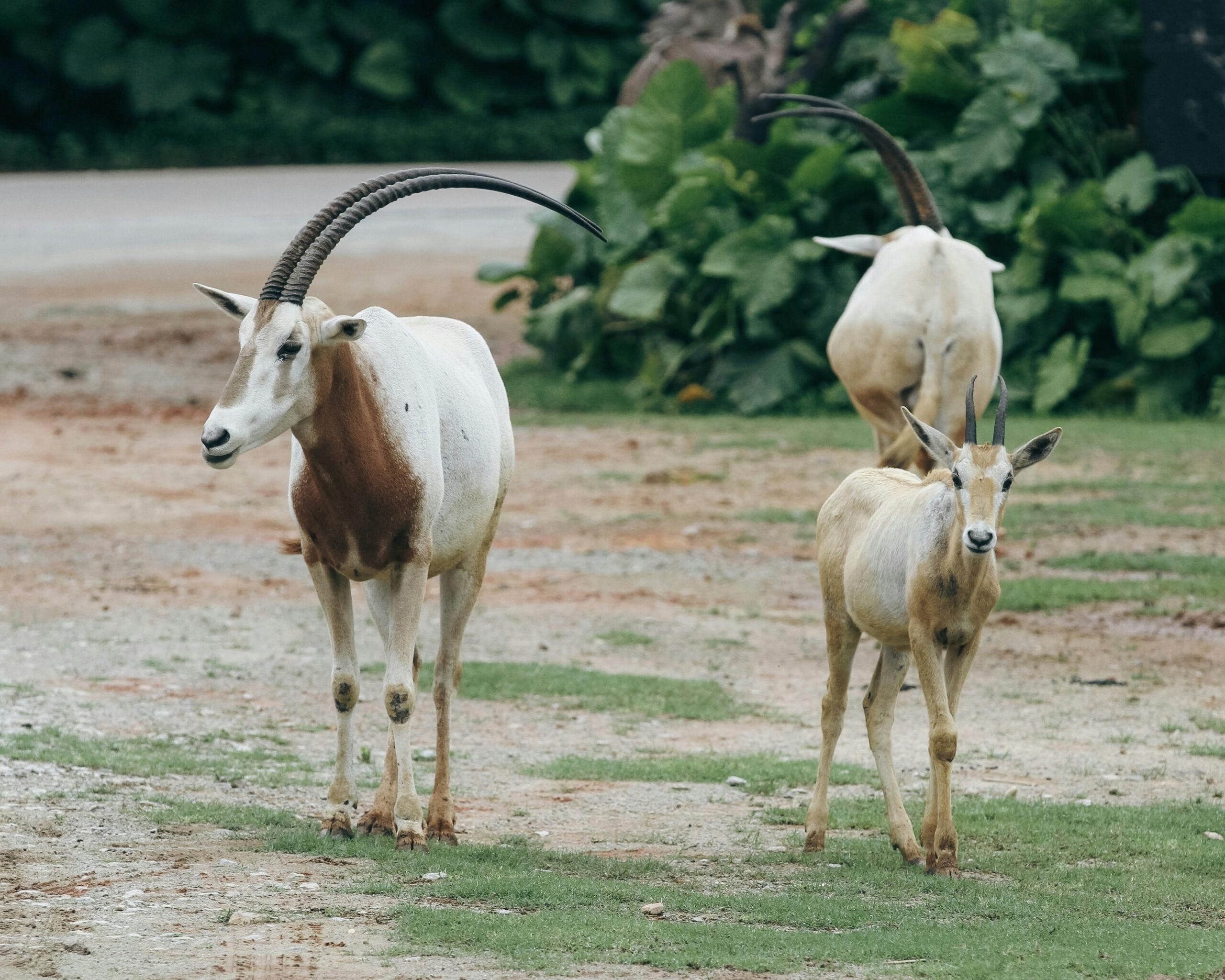
There is a theory (long debated, never fully resolved) that the scimitar-horned oryx may be the origin of the unicorn myth. When seen in profile, the two long curved horns of an adult overlap into a single sweeping arc. The ancient Egyptians depicted these animals in profile on tomb walls. Greek and Roman writers reported a one-horned animal from Africa. Whatever the truth of that lineage, the association carries a particular irony: by the year 2000, the scimitar-horned oryx had become, in the most literal sense, a mythological creature. The IUCN declared the species Extinct in the Wild. The animal that may have inspired the unicorn had itself become a legend.
In December 2023, the IUCN downlisted the scimitar-horned oryx (Oryx dammah) from Extinct in the Wild to Endangered, one of the most significant reversals ever achieved for a large mammal. More than 600 individuals were confirmed to be roaming freely in the Sahelian grasslands of central Chad, animals born wild from parents flown from the Arabian Peninsula as part of one of the most ambitious reintroduction programmes ever attempted. The unicorn had returned.
1. Species at a Glance
| Common Name | Scimitar-horned Oryx; Sahara Oryx |
| Scientific Name | Oryx dammah |
| Family | Bovidae (cattle, antelopes, goats, sheep) |
| IUCN Status | Endangered (EN), downlisted from Extinct in the Wild, December 2023 |
| Wild population | 600+ individuals in Chad (2024); first wild-born calves in 2016 |
| Captive population | ~4,000 in UAE; 220+ zoos and breeding centres worldwide |
| Historic range | Sahel and southern Sahara: from Senegal to Egypt and Sudan |
| Conservation note | First species under the IUCN’s Extinct in the Wild Action Partnership to be downlisted; one of only three large mammals (with the Arabian oryx and Przewalski’s horse) to have recovered from EW status |
2. Biology and Adaptation
The scimitar-horned oryx is a large antelope of the Bovidae family, standing just over 1 metre at the shoulder and weighing between 91 and 210 kg, with males considerably heavier than females. The coat is distinctive: predominantly white, with a reddish-brown neck and chest, and black markings on the forehead and along the nose. The white colouration is not incidental, it reflects solar radiation, helping the animal maintain body temperature in the extreme heat of the Sahara and Sahel. The hooves are broad and splayed, adapted for walking on sand. Dense eyelashes and strong eyelids protect against wind-driven grit.
The horns, which give the species its name, are long, ridged, sharply tipped, and curved backwards in a scimitar-like arc. Both males and females carry them. In adults, they can extend to 1.2 metres in length. The horns were the principal driver of the animal’s historical persecution: highly prized as trophies and for use in traditional medicine and ornamental objects across the Middle East and North Africa.
The species is among the most physiologically adapted large mammals to desert conditions. It can survive for months or even years without drinking water, deriving moisture from the plants it consumes. Its kidneys concentrate urine to minimise water loss; its body temperature can rise by up to 6°C above normal, a form of regulated hyperthermia that avoids the need for evaporative cooling through sweating. It can detect subtle variations in humidity carried on the wind over long distances, and migrates accordingly to follow rainfall and fresh grazing across the vast Sahelian belt.
Scimitar-horned oryx are highly gregarious, historically forming herds of hundreds or even thousands of individuals during seasonal migrations. They are grazers, feeding on grasses, herbs, juicy roots, and acacia seedpods. Females reach sexual maturity at around 18 months. Gestation lasts approximately 8 months, producing a single calf. In captivity, individuals have lived into their twenties; wild lifespan remains uncertain but is likely similar.
3 .The Collapse: How a Species Is Erased
At the start of the 20th century, scimitar-horned oryx ranged across the entire Sahel, the semi-arid belt stretching from Senegal and Mauritania in the west through Mali, Niger, Chad, and Sudan to Egypt in the east. Population estimates from the early 1900s suggest hundreds of thousands of animals. By 1988, perhaps a few hundred survived. By 2000, the IUCN could find no credible evidence that any remained in the wild at all.
The collapse was rapid and multi-causal. Colonial-era hunting, both for trophies and for commercial trade in horns and hides, removed enormous numbers from accessible areas in the early 20th century. Mechanised and motorised hunting accelerated dramatically after the Second World War, as vehicles and automatic weapons allowed hunters to pursue herds across terrain that had previously protected them. Political instability across the Sahel in the 1960s, 1970s, and 1980s put firearms into widespread circulation and eliminated the capacity of governments to enforce wildlife protection. Simultaneously, prolonged drought, compounded by the overgrazing of domestic livestock, degraded the vegetation cover that the oryx depended on. The animals retreated from their western and southern range, then from their central strongholds in Niger and Chad, until there was nowhere left to retreat.
The last confirmed photograph of a wild scimitar-horned oryx was taken in 1980, in the Aïr Mountains of Niger. Reports of small surviving groups in Chad persisted through the 1990s, but exhaustive surveys between 2001 and 2004 found no confirmed animals. The species was gone from its natural range within a single human lifetime.
4. Survival in Captivity
The species’ salvation had been inadvertently established during its decline. In the 1960s and early 1970s, small numbers of scimitar-horned oryx had been transported from the wild to zoos and private collections in Europe and the Arabian Peninsula, primarily as exhibits and status symbols. As wild populations collapsed, these scattered captive animals became the species’ entire biological legacy.
Coordinated management of this captive population began in the 1980s, as conservation biologists recognised that the wild population was likely already doomed. European and North American zoos established formal studbooks to track lineages and manage breeding. The Arabian Gulf states, particularly the UAE under the vision of Sheikh Zayed bin Sultan Al Nahyan, built large semi-wild herds in fenced reserves. By 2015, approximately 11,000 scimitar-horned oryx were held across Texas ranches alone; the global captive population numbered in the tens of thousands. The Environment Agency – Abu Dhabi (EAD) became the custodian of what was designated the “World Herd”: a carefully managed, genetically diverse population that would serve as the nucleus for eventual reintroduction.
5. The Return: From Abu Dhabi to Chad
The reintroduction to Chad’s Ouadi Rimé – Ouadi Achim Faunal Reserve, a protected area of approximately 78,000 km² (77,950 km², roughly the size of Scotland) in central Chad, was carefully prepared over years before the first animals arrived. The Chadian government committed to enforcing wildlife protection laws within the reserve. Sahara Conservation developed the on-the-ground infrastructure, trained Chadian rangers, and maintained the crucial dialogue between the programme and local pastoral communities whose livelihoods overlapped with the release area. The Royal Zoological Society of Scotland (RZSS) conducted genetic analyses of the founding herd to maximise diversity and minimise the risk of inbreeding. The Smithsonian’s National Zoo and Conservation Biology Institute led post-release monitoring through satellite collaring and field surveys.
When 25 animals landed in Chad on 14 March 2016, it was the first time scimitar-horned oryx had set foot in the country for nearly three decades. The first wild-born calf arrived in December of that year. By 2023, with 285 animals released in total, the wild population had grown to over 600 individuals, more than double the number released, testament to successful natural reproduction in the restored habitat. The December 2023 IUCN downlisting was the formal recognition of a conservation milestone that placed the species alongside the Arabian oryx and Przewalski’s horse as the only large mammals to have recovered from Extinct in the Wild status.
6. Endangered, Not Safe: What Remains to Be Done
The downlisting to Endangered is a milestone, not a conclusion. The recovered population exists in a single reserve in a single country, is descended from a relatively small founding group, and faces several ongoing and structural challenges.
Geographic concentration: The entire wild population occupies one reserve in Chad. A single catastrophic event, an outbreak of disease, an episode of intensive poaching, severe political instability in the region, could eliminate the wild population entirely. Expansion to additional sites in Niger, Tunisia, and elsewhere in the historical range is essential for long-term security.
Climate vulnerability: In 2024, an exceptionally long and hot dry season caused higher-than-usual mortality among the Chad population. The animals showed resilience, recovering as conditions improved, but the episode confirmed that a drying Sahel under climate change will periodically test the population in ways that are difficult to model or mitigate.
Poaching and governance: The reserve covers 78,000 km², making comprehensive patrol coverage difficult. Demand for oryx horns persists in some markets. Maintaining the Chadian government’s commitment to wildlife law enforcement in a region with significant governance pressures is a permanent requirement, not a solved problem. In July 2025, a 10-year management agreement signed between the Chadian government and Sahara Conservation formalised a shared governance model and a multi-year management plan for the reserve, a significant step, but one whose long-term effectiveness will depend on continued political stability and funding.
Genetic management: The World Herd captive population, while large in aggregate, is genetically fragmented across hundreds of institutions on multiple continents. Continued active management, including the Smithsonian’s artificial insemination programme for genetically valuable but behaviourally incompatible pairs, is needed to prevent genetic narrowing of the captive base.
Local community integration: The pastoral communities living in and around Ouadi Rimé – Ouadi Achim are key stakeholders. Their cooperation is not guaranteed; it depends on the programme continuing to deliver tangible benefits and to engage meaningfully with local governance structures.
7. Conclusion
The return of the scimitar-horned oryx to the wild is, objectively, one of the most significant conservation achievements of the 21st century. It demonstrates that a species can be held in trust in captivity, across generations and across continents, and returned to the wild in a self-sustaining form. It demonstrates that governments in the Global South, given appropriate resources and partnerships, can enforce wildlife protection in some of the most remote and logistically challenging terrain on Earth. And it demonstrates that the category “Extinct in the Wild” is not necessarily a terminus.
As ZSL’s Director of Conservation and Policy, Andrew Terry, observed when the downlisting was announced: “At a time when biodiversity is being lost at unprecedented rates, the return of the scimitar horned oryx can give us hope for other species whose fate is, quite literally, in our hands.”
The story is not finished. Endangered is not recovered. Six hundred animals in one reserve in one country is a foothold, not a population. But it is a foothold that did not exist twenty years ago, in a landscape where these animals had been absent for three decades. That is not nothing. That is, by any measure, something worth knowing.
As of the latest IUCN Red List update (version 2025-2), 88 species are classified as Extinct in the Wild.
Sources and Further Reading
IUCN Red List (2023). Oryx dammah. iucnredlist.org/species/15568/50191470
Sahara Conservation (December 2023). Milestone: The Scimitar-Horned Oryx Downlisted from Extinct in the Wild to Endangered
Sahara Conservation. Scimitar-Horned Oryx Reintroduction Project
ZSL (December 2023). Extinct in the Wild Antelope Brought Back from Brink of Extinction
RZSS. Scimitar-Horned Oryx WildGenes Programme
Smithsonian’s National Zoo and Conservation Biology Institute. Scimitar-Horned Oryx
BIAZA (2025). Back from the Brink: How Zoos and Monitoring Are Powering the Return of the Scimitar-Horned Oryx
Conservation Frontlines (July 2025). From Extinction to Endangered: The Scimitar-Horned Oryx’s Historic Comeback
Environment Agency – Abu Dhabi. Scimitar-Horned Oryx Reintroduction Programme
Smith, D., Abeli, T., Bruns, E. B., et al. (2023). Extinct in the Wild: The precarious state of the Earth’s most threatened group of species
Sahara Conservation (July 2025). A Historic Agreement for the Management of the Ouadi Rimé – Ouadi Achim Faunal Reserve in Chad