
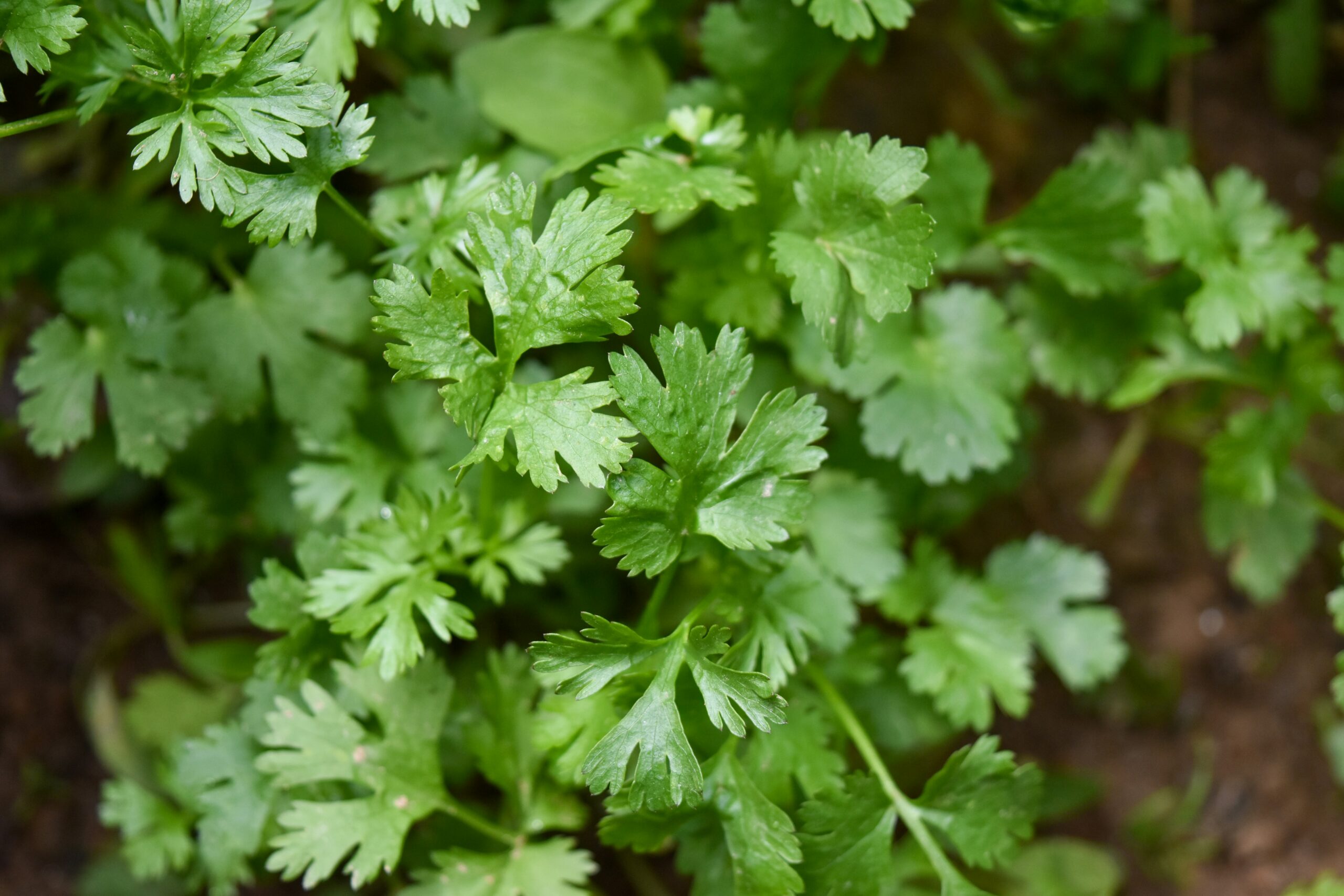
1. Botanical Profile
Coriandrum sativum is an annual herbaceous plant of the Apiaceae family, the same lineage as parsley, dill, fennel, carrot and celery. Native to a region spanning the eastern Mediterranean and western Asia, it has been cultivated for at least 7,000 years; coriander mericarps have been recovered from the late Neolithic Nahal Hemar cave in Israel and from the tomb of Tutankhamun. The plant produces finely divided, lobed lower leaves and feathery upper leaves, followed by characteristic umbels of small white-to-pale-pink flowers and round dry fruits (botanically schizocarps, commonly called “seeds”).
English-language usage splits the plant into two products with distinct culinary identities. In the United States and parts of Latin America, the fresh leaves are called cilantro while the dried seeds are called coriander. In British, Australian and most European usage, coriander refers to both, with “coriander leaf” and “coriander seed” distinguishing them. The split matters because the leaf and the seed have very different aromatic chemistry, nutrient profiles and uses. This article focuses on the fresh leaf.
Coriander grows quickly, typically 25 to 60 days from sowing to harvest of leaf, and prefers cool, well-drained conditions. It bolts (flowers and sets seed) under heat and long daylight, which is why commercial leaf supply often relies on succession planting and slow-bolt cultivars. It is also suitable to grow at small scale, including in containers.
2. Nutritional Composition
Cilantro is consumed in modest amounts, but per 100 g of fresh leaves it is a notably nutrient-dense ingredient:
Per 100 g
Source: USDA SR Legacy · Per 100 g · % DV based on FDA 2,000 kcal/day reference · Bars exceeding 100% DV are capped and shown in red
Three points stand out from this profile. First, the vitamin K1 (phylloquinone) content is exceptional: 100 g of cilantro provides several times the daily reference intake, placing it among the more concentrated dietary sources of K1 alongside kale and parsley. Second, vitamin C content is moderate but heat-sensitive, a relevant consideration for culinary use, as discussed below. Third, realistic serving sizes are small: a generous handful of chopped cilantro used as a garnish weighs around 4 to 8 g, delivering roughly 12 to 25 µg of vitamin K and a small but non-trivial contribution to daily folate, vitamin A and potassium intakes.
3. Bioactive Compounds
Cilantro’s chemistry is dominated by two families of compounds: aliphatic aldehydes and alcohols (responsible for most of the leaf’s distinctive aroma) and polyphenols (responsible for most of its measured antioxidant activity).
In the volatile fraction, gas chromatography studies of fresh cilantro essential oil consistently identify (E)-2-decenal, decanal, dodecanal, (E)-2-dodecenal and 1-decanol as principal constituents, often accompanied by smaller amounts of linalool. A compositional analysis published in the Saudi Journal of Biological Sciences (2021) identified 46 compounds representing more than 90% of the leaf’s aroma profile, with 1-decanol (17.85%), decanal (11.04%) and (E)-2-dodecen-1-ol (7.87%) leading the list. These medium-chain aldehydes are also produced in the defensive secretions of stink bugs (Pentatomidae), a chemical overlap that recurs in discussions of cilantro flavour perception.
In the non-volatile fraction, fresh leaves contain phenolic acids, including: caffeic, ferulic, p-coumaric and chlorogenic acids, and flavonoids, with quercetin and kaempferol reported across multiple HPLC analyses. A review in Nutrients (2023) summarised the evidence that these polyphenols underpin most of the antioxidant activity measured in cilantro extracts via DPPH, ABTS and FRAP assays. The same review noted that linalool, more abundant in coriander seed than in the leaf, is a major driver of the seed’s reported anti-inflammatory and antimicrobial activity in laboratory models.
4. The Genetics of Taste: OR6A2 and the “Soapy” Perception
Few culinary herbs divide opinion as sharply as coriander. A subset of consumers describe its flavour as fresh, citrusy and indispensable; others perceive it as soapy, metallic, or reminiscent of crushed insects. This is not a matter of cultural exposure alone, it has a measurable genetic component.
In a genome-wide association study published in the journal Flavour in 2012, Eriksson and colleagues at 23andMe analysed 14,604 participants of European ancestry who reported whether cilantro tasted soapy, with replication in a separate cohort of 11,851 participants who reported whether they liked cilantro. They identified a single-nucleotide polymorphism, rs72921001 (p = 6.4 × 10⁻⁹), within a cluster of olfactory receptor genes on chromosome 11. One of these genes, OR6A2, encodes an olfactory receptor with high binding specificity for several of the aldehydes that give cilantro its characteristic odour, the same (E)-2-decenal-type compounds described in the previous section.
Two nuances are worth emphasising. First, the heritability of soapy-taste detection tagged by common SNPs in that study was modest, about 0.087, meaning genetics is one factor among several, alongside experience, expectation and other unidentified inputs. Second, prevalence of the soapy-taste perception varies substantially by ancestry: the trait is more commonly reported in people of European and East Asian descent, and less commonly reported in populations whose cuisines have used cilantro extensively for centuries. A subsequent analysis by Mauer and El-Sohemy (2012) reported that the proportion of respondents disliking cilantro ranged from approximately 21% in East Asian samples and 17% in samples of European ancestry to 3-7% in samples of South Asian, Hispanic and Middle Eastern ancestry.
5. Health Effects: What the Evidence Says
A note on scope. Most clinical research published under the heading “coriander” has used seed preparations: powder, extract or essential oil, rather than fresh leaf. This matters because the seed and the leaf differ in chemistry. The discussion below focuses on the evidence that is specifically relevant to the leaf, with appropriate qualifiers where the inference is indirect.
Antioxidant activity
Multiple in vitro studies have documented the antioxidant activity of cilantro leaf extracts. In a comparative analysis of three Apiaceae species published in Evidence-Based Complementary and Alternative Medicine (2020), coriander, parsley and celery polyphenol extracts all showed significant DPPH and FRAP scavenging activity, with coriander’s profile correlated to its quercetin and kaempferol content.
Antimicrobial activity
Cilantro essential oil and aqueous leaf extracts have demonstrated activity against several foodborne bacteria, including: Escherichia coli, Staphylococcus aureus, Listeria monocytogenes and Salmonella species, in laboratory inhibition assays. The aldehyde fraction, particularly (E)-2-dodecenal, has been singled out as a principal contributor. Whether these in vitro effects translate to clinically meaningful outcomes when cilantro is consumed as a fresh garnish remains unproven, and the doses used in laboratory work typically far exceed culinary exposure.
Heavy metal binding
A frequently repeated claim is that cilantro “detoxifies heavy metals.” The empirical basis is mostly preclinical: cell-culture and rodent studies suggest that cilantro extracts may bind certain heavy metals and influence their excretion. There is no robust human clinical evidence that ordinary dietary cilantro consumption produces clinically meaningful chelation, and the claim should be regarded as a hypothesis rather than an established benefit.
7. Culinary Applications
Cilantro is one of the few herbs that anchors flavour profiles across multiple unrelated culinary traditions. The leaf is almost always added late or raw, because its volatile aldehydes are heat-sensitive and oxidise rapidly under prolonged cooking.
- Mexico and Central America: indispensable in salsas (verde and roja), guacamole, ceviche, pozole and as the finishing herb on tacos. Mexican cuisine also uses the cilantro stem, which is more crisp than the leaf and holds up better to slight heat.
- Vietnam and Thailand: integral to phở, bún bò Huế, nam tok and many salads. Thai cuisine often uses the entire plant (root, stem and leaf) with the root pounded into curry pastes for a deeper, earthier note.
- India and Pakistan: cilantro chutney (with green chilli, ginger and lime) is a daily condiment; the leaf is folded into dal and curries at the end of cooking and forms the green flecking in countless rice dishes.
- Levant and North Africa: cilantro is the dominant green in Moroccan chermoula, in many Egyptian and Lebanese stews, and in Yemeni zhug/sahawiq, a hot herb sauce.
- East Africa and the Swahili coast: dhania, the Swahili name for cilantro, borrowed from Hindi via Indian Ocean trade, is woven through everyday cooking in Kenya, Tanzania and Zanzibar. It appears as a finishing herb in pilau (spiced rice), kuku paka (coconut-and-cilantro chicken curry) and kachumbari (tomato-and-onion relish), and in the marinades for grilled meats and fish.
- Portugal: among European cuisines, Portuguese cooking is unusual in its strong cilantro tradition, particularly in the Alentejo and Algarve regions, açorda alentejana (a bread-and-coriander soup) and amêijoas à Bulhão Pato rely on the herb as a defining flavour, a heritage often attributed to historical Moorish influence on the Iberian Peninsula.
Pairing principles. Cilantro pairs naturally with acidic counterpoints: lime, lemon, tomatillo, sumac, and with chilli heat (capsaicin appears to attenuate the soapy perception in susceptible tasters). It works less well alongside strongly resinous Mediterranean herbs such as rosemary or sage, whose terpenes can clash with cilantro’s aldehydes.
8. Selecting, Storing and Preparing
Selecting. Quality fresh cilantro should have firm, upright stems and bright green leaves with no yellowing, sliminess or wilt. Aroma should be assertive and citrusy when leaves are gently rubbed. Bunches with attached roots (common in many Asian markets) store longer than trimmed bunches.
Storing. For domestic storage, cilantro keeps best refrigerated at 1-4 °C with stems immersed in a glass of water and the leaves dry. Treated this way, fresh bunches typically hold 7-14 days. Pre-washing accelerates decay; wash only the portion to be used. For longer storage, freezing in ice cube trays with water or olive oil preserves most of the herb’s flavour for cooked applications, while drying reduces both volatile aroma and vitamin C content substantially and is generally not recommended for the leaf.
Preparing. Add fresh cilantro at the end of cooking or use it raw to preserve its volatile compounds and vitamin C. Heat applied for more than 1-2 minutes degrades both. Both the leaf and the upper stem are edible and flavourful; the lower stem, while edible, is more fibrous. Roots are widely used in Thai cuisine and are worth keeping if available.
9. Precautions and Considerations
- Apiaceae cross-reactivity. People with allergies to other Apiaceae species: celery, carrot, parsley, fennel, anise, may experience cross-reactive symptoms with cilantro, ranging from oral allergy syndrome to, rarely, anaphylaxis. The EFSA Panel on Dietetic Products, Nutrition and Allergies lists celery as a major allergen requiring labelling under EU regulations; cilantro is not separately regulated but the cross-reactivity pattern is well documented.
- Vitamin K and anticoagulants. Cilantro’s high vitamin K1 content is a consideration for people on vitamin K antagonists such as warfarin. Clinical guidance from anticoagulation services is to maintain consistent vitamin K intake rather than to avoid leafy greens; abrupt large changes in cilantro consumption should be discussed with the prescribing clinician.
- Pesticide residues. Fresh leaf herbs are routinely identified in EU and US monitoring programmes as a category in which residue compliance varies by origin. The EFSA Annual Report on Pesticide Residues in Food provides annually updated compliance data; certified organic cilantro mitigates this exposure category and is subject to the controls specified in EU Regulation (EU) 2018/848 on organic production.
- Pregnancy and lactation. Cilantro is generally regarded as safe at culinary intakes during pregnancy and contributes folate, an important nutrient in early pregnancy. Concentrated extracts and essential oils have not been adequately studied for safety in pregnancy and are best avoided.
10. Conclusion
Coriander as a unique role in many unrelated culinary traditions. The same fresh leaf flecks Mexican salsas and Vietnamese phở, anchors Moroccan chermoula and Egyptian ta’ameya, ties together Thai curry pastes and Indian chutneys, and finishes Swahili pilau and Portuguese açorda alentejana. In each of these cuisines, coriander is not an interchangeable garnish; it carries enough of the dish’s flavour identity that substituting it, even with closely related flat-leaf parsley, produces something recognisably different. That kind of structural role across geographically and culturally disconnected traditions is uncommon for any single herb, and it places coriander in a group of ingredients whose absence is felt rather than overlooked.
Coriander is a reliable contributor of vitamin K1, vitamin C, folate and a small but well-characterised set of polyphenols. Most of the clinical evidence on cardiometabolic effects relates to the seed rather than the leaf, and the often-repeated heavy-metal-detoxification claim remains a hypothesis rather than an established outcome.
For consumers, the practical implications are simple: buy fresh, store cool with stems in water, add late in cooking, choose organic when possible to limit pesticide exposure, and trust that the polarising flavour is, for some people, written into their olfactory receptors.
Switch between Fresh and Dried to explore nutrients per serving. Values scale proportionally to your chosen weight.
─────────────────────────────
This article is part of Bem Bloom’s Aromatic Herbs series. All information is provided for informational purposes only. It is not a substitute for professional medical or nutritional advice. Consult a qualified healthcare professional before making significant changes to your diet.
Sources and Further reading
9. European Food Safety Authority. Pesticide residues in food: annual reports. EFSA.
11. Royal Horticultural Society. Coriander (Coriandrum sativum): plant profile. RHS.