
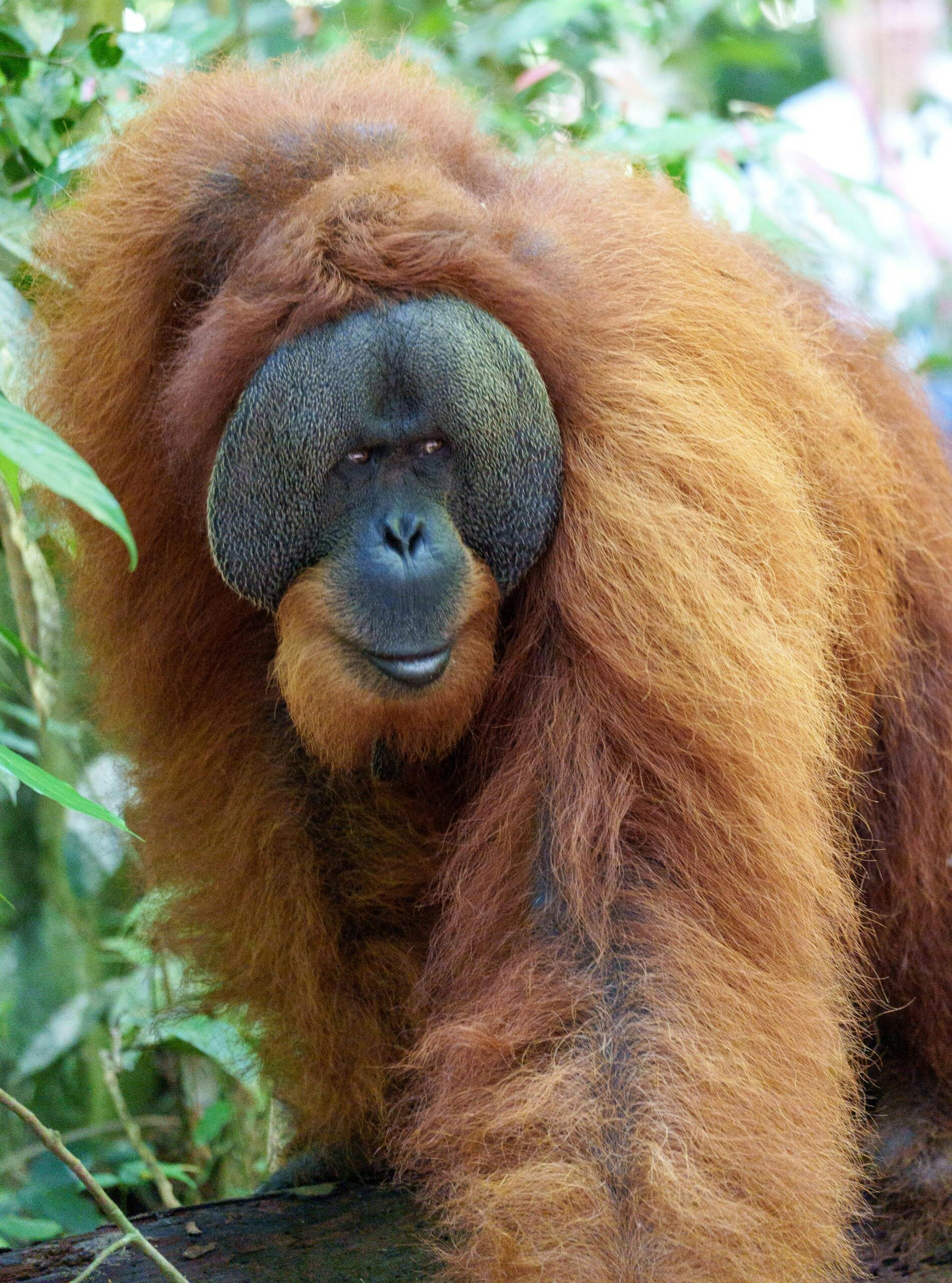
In 2022, a wild Sumatran orangutan named Rakus was observed doing something no animal had ever been documented doing before: he chewed the leaves of Fibraurea tinctoria, a plant used in traditional medicine across Southeast Asia, and applied the resulting paste directly to a wound on his face. Within five days the wound had closed, and within several weeks it had healed to a faint scar. The observation, published in Scientific Reports, was the first systematically documented case of active wound treatment with a biologically active plant by a wild animal, a moment that again reshaped our understanding of the cognitive sophistication of one of our closest relatives.
The Sumatran orangutan (Pongo abelii) shares approximately 97% of its DNA with humans. They are one of only three great ape species found outside of Africa, the other two being their close relatives, the Bornean Orangutan and the Tapanuli Orangutan. They construct sleeping nests each night, use tools, pass cultural traditions between generations, and solve problems with a deliberateness that primatologists describe as genuinely reflective. They are also Critically Endangered, confined to a single ecosystem in northern Sumatra that is being dismantled, hectare by hectare, for palm oil.
Species at a Glance
| SPECIES AT A GLANCE | |
|---|---|
| Common Name | Sumatran Orangutan (‘person of the forest’ in Malay) |
| Scientific Name | Pongo abelii |
| Family | Hominidae (great apes) |
| IUCN Status | Critically Endangered (CR) – since 2000 |
| Population | 14,613 individuals (2016 survey; population declining) |
| Range | Northern Sumatra, Indonesia only; ~90% in Leuser Ecosystem |
| Primary Threats | Habitat loss (palm oil, logging), fragmentation, poaching |
| First Described | Classified as distinct species from Bornean orangutan in 2001 |
Biology and Behaviour
Sumatran orangutans are the largest arboreal mammals on Earth, animals that spend almost their entire lives in the canopy of the forest. Females average around 45 kg and 90 cm in height; males are considerably larger, reaching 90 kg and 1.7 m. Adult males exist in two distinct morphs: flanged males, who develop prominent cheek pads (called flanges), a large throat pouch, and the characteristic long call that can carry up to 1 km through the forest; and unflanged males, who remain smaller and can delay the development of secondary sexual characteristics for years or even decades. Both morphs are sexually mature and capable of reproduction.
The species is overwhelmingly frugivorous. Fruit, particularly figs and other large-seeded forest fruits, makes up the majority of the diet, supplemented by leaves, bark, insects, and occasionally small vertebrates. Because fruit availability in tropical rainforests is highly seasonal and patchy, orangutans maintain large home ranges and possess an exceptional spatial memory for the location and timing of fruiting trees. This cognitive demand has been proposed as one factor contributing to the species’ large brain relative to body size.
Sumatran orangutans are notably more social than their Bornean counterparts, frequently congregating at fruit-rich trees and forming loose associations. They are one of the few non-human animals known to exhibit cultural transmission, learned behaviours that vary between populations and are passed from mother to offspring over years of close contact. Tool use, specific food-processing techniques, and even particular styles of nest construction differ between groups in ways that cannot be explained by genetics or environment alone. The 2022 observation of Rakus self-medicating represents one of the most striking recent examples of this behavioural sophistication.
Reproduction is exceptionally slow. The interbirth interval, the time between successive births, averages 9.3 years for Sumatran orangutans, the longest of any great ape. A female will typically produce three to five offspring in her lifetime. Gestation lasts approximately 260 to 270 days. Infants remain in constant contact with their mothers for the first two years and in close association for up to eight years, one of the longest periods of maternal dependency in the animal kingdom. This life history, so similar to our own, means that population recovery from any significant decline is measured in decades, not years.
Habitat and Range
The Sumatran orangutan is endemic to the northern portion of the Indonesian island of Sumatra. Approximately 90% of the remaining population lives within the Leuser Ecosystem, a 2.6 million hectare landscape of primary rainforest, peat swamps, rivers, and montane forest in Aceh Province, widely considered one of the most biodiverse places on Earth. The Leuser is the only place in the world where orangutans, Sumatran tigers, Sumatran elephants, and Sumatran rhinos still coexist in the same forest. It is, by any measure, irreplaceable.
Sumatran orangutans prefer lowland forest below 500 metres, where the largest and most productive fruiting trees grow. This preference is also their greatest vulnerability: lowland forest is precisely the terrain most targeted for conversion to oil palm and other agriculture, because it is flat, accessible, and close to existing road networks. The peat swamp forests that fringe the Leuser’s western coast (among the highest-density orangutan habitat remaining), sit on carbon-rich soils that, when drained for agriculture, become irreversibly degraded and acutely fire-prone.
What Is Driving the Decline
The Sumatran orangutan faces a convergence of threats, all rooted in the same underlying dynamic: the rapid conversion of Sumatra’s lowland forests to industrial agriculture and other human land uses. The IUCN estimates that key lowland habitat declined by 60% between 1985 and 2007 alone, a loss that models project will produce an 81% reduction in the total Sumatran orangutan population between 1985 and 2060 if current trends continue.
| Threat | Mechanism | Impact |
|---|---|---|
| Palm Oil Expansion | Conversion of lowland rainforest and peat swamp to plantation. The Leuser Ecosystem loses forest to illegal oil palm even within legally protected reserves. | Primary driver; forest loss of 60% of key lowland habitat between 1985 and 2007. |
| Logging (legal & illegal) | Selective and clear-cut logging removes canopy and opens roads into previously inaccessible forest, enabling secondary encroachment. | Fragments habitat and allows poachers easier access to previously remote populations. |
| Poaching & Pet Trade | Adults killed (often by burning or trapping) and infants taken for the illegal exotic pet trade in Indonesia and internationally. | Each infant taken typically costs the life of the mother and 1-2 other adults defending her. |
| Infrastructure & Roads | Road construction through the Leuser Ecosystem fragments contiguous forest into isolated patches, cutting gene flow between populations. | Fragmented populations of fewer than 250 individuals are not viable over the long term. |
| Peatland Drainage | Draining of carbon-rich peat swamp forests for agriculture renders habitat permanently unsuitable and creates fire risk. | Peat swamps hold the highest densities of Sumatran orangutans; once drained, recovery takes centuries. |
Palm oil expansion is the central thread connecting many of these pressures. Indonesia and Malaysia together produce more than 85% of the world’s palm oil, and Sumatra is the primary growing region. In a landmark 2024 investigation, the Rainforest Action Network (RAN) documented ongoing illegal deforestation within the Rawa Singkil Wildlife Reserve, a nationally protected area within the Leuser that harbours the densest concentration of Sumatran orangutans on Earth, with an estimated 1,500 individuals. Satellite imagery confirmed that illegal oil palm plantations were actively expanding inside the reserve’s boundaries, and that palm oil from these plantations was entering the supply chains of globally recognised consumer brands.
This is not a distant abstraction. Palm oil is present in an estimated 50% of all packaged consumer goods, from biscuits and margarine to cosmetics, shampoo, and cleaning products. When it is produced through deforestation in the Leuser Ecosystem, it comes at the direct cost of orangutan habitat. The connection between a product on a European supermarket shelf and a hectare of primary rainforest cleared in Aceh is real, traceable, and ongoing.
Conservation Efforts
The primary organisation dedicated to Sumatran orangutan conservation in the field is the Sumatran Orangutan Conservation Programme (SOCP), which operates a rescue, rehabilitation, and reintroduction programme, and conducts population monitoring across the species’ range. The Borneo Orangutan Survival Foundation (BOS) operates parallel programmes focused on Borneo Orangutan, across both islands. Together these organisations have reintroduced hundreds of rehabilitated individuals into protected forest over the past two decades.
- Gunung Leuser National Park, a UNESCO World Heritage Site, protects a core block of the Leuser Ecosystem and serves as the single most important protected area for the species. However, illegal encroachment continues even within its boundaries.
- Reintroduction programmes have established a self-sustaining wild population in Bukit Tiga Puluh National Park in Jambi and Riau provinces, a cautious proof of concept that recovery is biologically possible with habitat protection.
- The EU Deforestation Regulation (EUDR), adopted in 2023 (in force since December 30, 2026, for large and medium operators, and June 30, 2027, for micro and small enterprises), requires companies to verify that products, including palm oil, are not linked to deforestation. If enforced, this represents one of the most significant regulatory levers yet applied to the supply chains driving orangutan habitat loss.
- Community-based conservation, including support for alternative livelihoods for forest communities and engagement with local adat (customary) land governance, is increasingly recognised as essential for protecting forests that lie outside formal protected area boundaries.
Is There Hope?
The situation is serious but not irreversible. The Sumatran Orangutan has a population large enough that recovery remains biologically possible, if habitat loss can be halted and the remaining forest protected. The species’ intelligence, adaptability, and existing captive and wild managed populations provide a foundation that many Critically Endangered species lack.
What is required is a combination of rigorous enforcement of existing protections (particularly in the Leuser Ecosystem), credible supply chain due diligence by palm oil consumers and traders, and sustained investment in rehabilitation and reintroduction. The EUDR, if implemented with genuine rigour, could transform the economics of deforestation at scale. Consumer pressure, especially in markets where certified sustainable palm oil or palm-oil-free alternatives are commercially viable, translates directly into purchasing decisions by the companies whose supply chains currently run through the Orangutan Capital of the World.
The Sumatran orangutan’s story is, in the most direct way possible, a story about the choices that industrial food and consumer goods systems make every day. It is also a story about what is still possible, if those choices change.
Sources and Further Reading
IUCN Red List (2017). Pongo abelii. iucnredlist.org/species/121097935
Wich, S.A. et al. (2016). Land-cover changes predict steep declines for the Sumatran orangutan. Science Advances.
Laumer, I.B. et al. (2024). Active self-treatment of a facial wound with a biologically active plant by a Sumatran orangutan. Scientific Reports.
Rainforest Action Network (2024). Orangutan Capital Under Siege. ran.org/leuser-watch
Rainforest Action Network / Mongabay (2024). Palm oil deforestation persists in Indonesia’s Leuser amid new mills. Mongabay.
Sumatran Orangutan Conservation Programme (SOCP). About Orangutans. sumatranorangutan.org
WWF (2024). Sumatran Orangutan. worldwildlife.org
New England Primate Conservancy (2024). Sumatran Orangutan (Pongo abelii). neprimateconservancy.org
European Commission (2023). EU Deforestation Regulation. environment.ec.europa.eu