
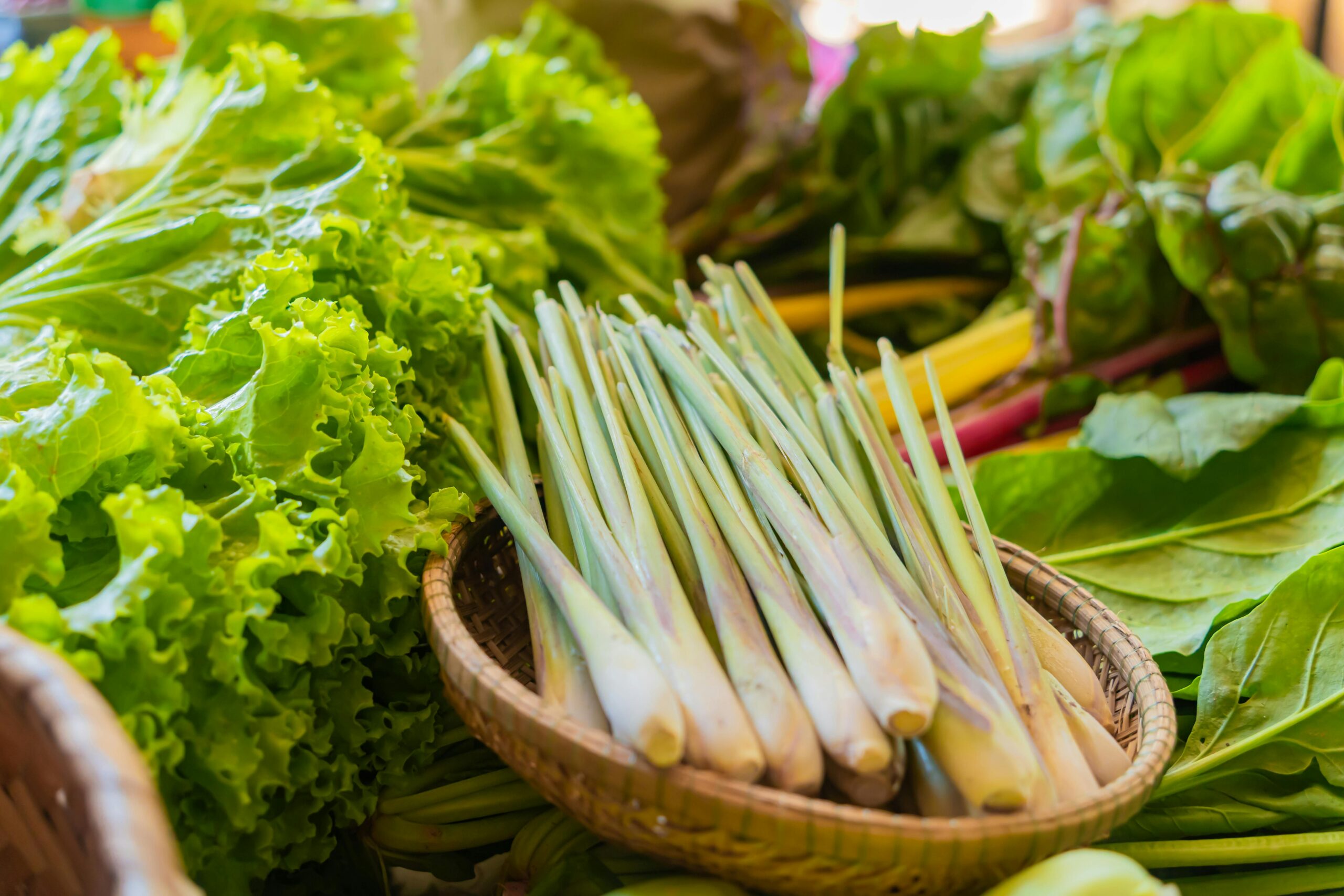
1. Botanical Profile
Cymbopogon citratus (DC.) Stapf is a tall, perennial, densely tufted grass native to South and Southeast Asia. It belongs to the genus Cymbopogon, which contains around 55 species of fragrant grasses, and to the family Poaceae, the same botanical family as wheat, rice and bamboo. As a culinary herb, lemongrass is unusual: most aromatic herbs come from the mint, parsley or daisy families, and relatively few grasses are used primarily as aromatic culinary herbs.
The plant grows in dense clumps that can reach 1.5 metres in height, with bluish-green linear leaves that release the characteristic lemony scent when bruised. The part used in cooking is the lower stalk, the white-to-pale-green base of the leaf bundle, where the volatile oils are most concentrated. The fibrous upper leaves are used to make infusions and decoctions but are typically removed before serving when used in solid form.
Lemongrass thrives in tropical and subtropical climates with well-drained soils and abundant rainfall, and is now cultivated commercially across South and Southeast Asia, parts of Africa, Madagascar, the Caribbean and Central and South America. According to a 2023 review in the International Journal of Current Science Research and Review, the plant rarely flowers under cultivation and is propagated almost exclusively by clump division.
2. Two Species, Two Destinies:
C. citratus and C. flexuosus
Although they share a name and a citrus aroma, Cymbopogon citratus and Cymbopogon flexuosus are two distinct species with different geographic origins, chemical profiles and dominant uses.
2.1 West Indian Lemongrass (Cymbopogon citratus)
Native to South and Southeast Asia, C. citratus is the species grown across Thailand, Vietnam, Indonesia, Malaysia, the Philippines, Cambodia and Sri Lanka, the species you find in fresh-produce markets and recipes. Despite the misleading common name West Indian lemongrass (a label inherited from its early colonial spread to the Caribbean), it is the primary culinary species worldwide. Its essential oil contains higher levels of myrcene, which gives the fresh stalk a more rounded, slightly herbaceous character, but myrcene also degrades faster, making the oil less stable for industrial use.
2.2 East Indian Lemongrass (Cymbopogon flexuosus)
Native to India, C. flexuosus is also known as Cochin or Malabar lemongrass. Its essential oil typically contains 75-85% citral with substantially lower myrcene content than C. citratus, which translates into a longer shelf life and greater oxidative stability. For these reasons, C. flexuosus dominates the global essential-oil and perfumery industry, and is the species most commonly traded as commercial lemongrass oil. India remains the principal producer; according to industry data compiled by Global Market Insights, Guatemala and India together account for the majority of global lemongrass oil exports.
2.3 Why the Distinction Matters
For cooking, C. citratus is the species you want, its rounder aromatic profile is what defines Southeast Asian dishes. For aromatherapy, perfumery, food-grade flavouring concentrates and antimicrobial research, C. flexuosus is more often the source. Both species share the same dominant active compound (citral), and most studies cited in the scientific literature, particularly older pharmacological work, were conducted on whichever species was locally available. Readers comparing studies should check which species was used.
3. Nutritional Composition
Lemongrass is consumed in small culinary quantities (typically 5-15 g per portion of stalk, or a teabag for infusion), so its real nutritional contribution per dish is modest. The chart below show the per-100 g profile of raw stalks:
Raw · Per 100 g
Source: USDA SR Legacy · Lemongrass raw · Per 100 g · % DV based on FDA 2,000 kcal/day reference · Bars exceeding 100% DV are capped and shown in red
The headline figures are manganese, iron and potassium. A 100 g portion would supply more than two and a half times the EU daily reference for manganese, but a typical culinary serving of one 10 g stalk delivers around 0.5 mg, still useful but less remarkable. As the pillar article for aromatic herbs notes, herbs are not eaten for macronutrients; their role is to deliver flavour, aroma and small amounts of micronutrients and bioactive compounds.
4. Bioactive Compounds
Lemongrass owes its aroma and most of its reported biological activity to its essential oil, which makes up roughly 0.2-0.4% of the fresh weight of the leaves. The volatile fraction is dominated by monoterpenes; the non-volatile fraction includes flavonoids and phenolic acids.
Citral (geranial + neral)
The defining compound of lemongrass is citral, a mixture of two stereoisomeric monoterpene aldehydes, geranial (E-citral) and neral (Z-citral). In a phytochemical analysis of Thai-grown C. citratus essential oil published in 2024, geranial and neral together accounted for 79.2% of the volatile profile, with geranial at 44.5% and neral at 34.7%, figures consistent with the broader literature. Citral is responsible for both the bright lemony scent and most of the antimicrobial, antifungal and anti-inflammatory activity reported in laboratory studies.
Myrcene, Geraniol, Citronellal
Beyond citral, lemongrass essential oil contains myrcene (a monoterpene with a balsamic, slightly herbaceous note and reported peripheral analgesic activity in animal models), geraniol (rose-citrus aroma, with mild antimicrobial properties), and citronellal, also prominent in citronella grasses used for insect-repellent oils. The proportions of these minor compounds are what most clearly distinguish C. citratus from C. flexuosus, the West Indian species being noticeably higher in myrcene.
Polyphenols and Flavonoids
Beyond the volatile oil, lemongrass leaves contain C-glycosylflavonoids, particularly isoorientin, swertiajaponin and isoorientin 2″-O-rhamnoside, together with phenolic acids such as chlorogenic acid and caffeic acid. A study published in Molecules (2009) showed that these flavonoids inhibit copper-induced oxidation of human LDL in vitro, offering a possible mechanistic basis for the antioxidant activity observed in lemongrass infusions.
5. Scientific Evidence
Lemongrass has a long ethnobotanical record of use for digestive, antimicrobial, sedative and antipyretic purposes. The modern evidence base is uneven: laboratory and animal data are abundant, but well-designed human trials are still scarce, and many published clinical studies are small, short or have methodological limitations.
5.1 Antimicrobial and Antifungal Activity
This is the strongest area of evidence. Citral-rich lemongrass essential oil shows broad-spectrum antimicrobial activity in vitro against bacteria such as Escherichia coli, Staphylococcus aureus, Streptococcus agalactiae and Cutibacterium acnes, as documented in the 2024 Thai phytochemical study cited above. A 2024 scoping review in the South African Journal of Botany synthesised the antifungal data and found consistent activity against Candida species and dermatophytes across in vitro studies, while noting that translational research in humans remains limited.
On the human side, a PRISMA 2020 systematic review (Clinical, Cosmetic and Investigational Dentistry, 2024) examined the use of C. citratus preparations for oral candidiasis, including in HIV/AIDS patients. The included studies suggested efficacy comparable to the conventional control (gentian violet), with fewer adverse effects, although the authors noted the small number of trials and the heterogeneity of preparations as significant limitations.
5.2 Cardiovascular and Metabolic Markers
A 2022 narrative review titled “Exploring the Anti-Hypertensive Potential of Lemongrass” (Biology) pulled together the evidence across in vitro, ex vivo, animal and clinical studies. The proposed mechanisms, endothelial nitric-oxide release, calcium-channel blockade in vascular smooth muscle, and a centrally mediated parasympathetic effect of citral, are consistent across preclinical models, but the authors concluded that clinical evidence in humans remains scarce and that adequately powered randomised trials are still needed before any blood-pressure benefit can be considered established.
A 2011 mouse study in Food and Chemical Toxicology found that 21-day oral administration of lemongrass essential oil reduced blood cholesterol at the highest tested dose (100 mg/kg), without genotoxic or organ-toxicity signals. This finding has not yet been replicated in a controlled human trial.
5.3 Anxiolytic and Sleep Effects
Animal studies, including work by Costa et al. (Journal of Ethnopharmacology, 2011), suggest that lemongrass essential oil acts on the GABAA receptor–benzodiazepine complex, producing anxiolytic-like effects in rodents. In humans, the picture is less clear. A 2025 randomised clinical trial in BMC Complementary Medicine and Therapies reported reduced dental anxiety in patients undergoing scaling and root planing after inhaling lemongrass essential oil, consistent with the GABAergic mechanism. By contrast, an earlier human study of oral lemongrass tea found no significant effect on anxiety or sleep in healthy volunteers. The Memorial Sloan Kettering monograph on lemongrass reflects this divergence: aromatherapy applications show some signal; oral teas, less so.
5.4 What the Evidence Does Not Support
Marketing claims that lemongrass tea reliably treats infections, prevents cancer, induces sleep or lowers blood pressure in humans go well beyond what current trials demonstrate. The plant has a credible bioactive profile and a broad folk-medicine record, but most claims that appear on consumer packaging are based on in vitro or rodent data and have not been validated in adequate clinical trials.
6. Production and Global Market
Lemongrass is sold in three principal commercial forms: fresh stalks (the dominant culinary form, traded regionally and increasingly globally through Asian-grocery and supermarket channels), dried and powdered stalks (used in spice blends, marinades and tea bags), and essential oil, produced by steam distillation of the leaves and stems and traded as a pharmaceutical, cosmetic and flavour ingredient.
6.1 Cultivation and Origin
According to data compiled by India’s Council of Scientific and Industrial Research (CSIR-CIMAP) and reported by Global Market Insights, global lemongrass essential-oil production is estimated at around 1,000 tonnes per year, of which 300-400 tonnes are exported to the United States, the United Kingdom, Germany, Australia and Japan. India and Guatemala are the leading exporters; the United States and Russia are among the largest importers. The fresh-stalk trade is more dispersed, with significant flows from Thailand, Vietnam and Sri Lanka into European and North American Asian-grocery supply chains.
7. Culinary Applications: The Southeast Asian Anchor
More than any other aromatic herb, lemongrass functions as a regional flavour signature. Where bay leaf signals Mediterranean braising and rosemary signals Provençal roasting, lemongrass, alongside galangal, kaffir lime leaf, and fresh chillies, is the unmistakable opening note of Southeast Asian cooking. The herb’s bright, lemon-citrus aroma carries through long simmering and high-heat stir-frying without breaking down, which is what makes it indispensable to the region’s curry pastes, soups and braises.
7.1 Preparing the Stalk
Only the lower 10-15 cm of each stalk is tender enough to use directly. Three preparations dominate Southeast Asian kitchens:
- Bruised whole pieces: the stalk is trimmed, cut into 5 cm lengths, and crushed with the side of a knife or a pestle to release the oils. Used to infuse soups, broths and braises, then removed before serving (as in Thai tom yam or Vietnamese phở).
- Finely sliced: the tender heart of the stalk is cut into very thin rings or minced, then pounded into curry pastes (Thai nam phrik, Indonesian bumbu) or stirred into salads and stir-fries.
- Pounded into pastes: with shallots, garlic, galangal, chillies and shrimp paste, lemongrass forms the aromatic base of countless wet-spice mixtures across the region.
7.2 The Region’s Defining Dishes
Thailand. Lemongrass anchors the trio of aromatics, alongside galangal and kaffir lime leaf, that defines tom yam hed (the mushroom version of the iconic ต้มยำ (tom yam)) and tom kha tao hu (coconut-galangal soup with tofu and oyster mushrooms). It is equally central to the country’s red, green and panang curry pastes, used across Thailand in vegetable, tofu and tempeh curries. Thailand has a long-established Buddhist vegan tradition known as อาหารเจ (ahaan jay), particularly visible during the annual Vegetarian Festival, in which the same lemongrass-driven pastes, made without shrimp paste or fish sauce, appear in dishes such as lemongrass-marinated tofu skewers, pad krapow with crumbled mushroom or soy mince, and lemongrass-scented vegetable stir-fries.
Vietnam. Vietnam has one of Southeast Asia’s most developed plant-based culinary traditions: ăn chay, rooted in Mahayana Buddhist practice and widely available in everyday restaurants. Lemongrass is at its heart. Đậu hũ sả ớt (lemongrass-chilli tofu) is one of the most-cooked Vietnamese home dishes, vegan or otherwise. Phở chay, the plant-based version of phở, builds its broth on bruised lemongrass stalks, charred ginger, star anise, daikon and dried shiitake. Finely minced lemongrass also drives nấm xào sả (lemongrass mushroom stir-fry), bún chay (vegan rice-noodle bowls), and the marinade for grilled tofu and seitan that dominates southern Vietnamese plant-based menus.
Indonesia and Malaysia. Lemongrass, locally serai, is one of the core bumbu aromatics, equally indispensable in plant-based and animal-based cooking. Sayur lodeh, the Javanese vegetable-coconut curry, and gulai nangka, made from young jackfruit, both rely on lemongrass-rich bumbu pastes. Tempeh and tofu cooked in lemongrass-and-turmeric pastes are everyday staples across Java. The same paste structure underpins plant-based versions of soto, the sambals served with nasi lemak, and Malaysian laksa, where mushrooms, tofu puffs and vegetables stand in for the seafood or chicken found in restaurant versions. Indonesia’s rendang, traditionally a slow-cooked beef dish, has well-established vegan adaptations using jackfruit or king oyster mushrooms, the lemongrass-galangal-chilli paste does the heavy lifting either way.
Cambodia. Cambodia’s lemongrass-dominant kroeung pastes are the foundation of Khmer cuisine and translate readily to plant-based cooking. Amok, a steamed coconut-lemongrass curry classically made with fish, is increasingly served as amok phset (mushroom amok) or pumpkin amok in Phnom Penh’s growing roster of vegan and Buddhist restaurants. Lemongrass-grilled tofu and vegetable skewers, lemongrass-scented soups (samlor) made with banana blossom or jackfruit, and lemongrass-coconut braises with tempeh are common adaptations of the country’s flavour grammar.
Sri Lanka. Known as sera, lemongrass flavours many of the naturally vegan curries that make up everyday Sri Lankan eating: parippu (red lentil curry), polos (young jackfruit curry), kiri hodi (a coconut-milk gravy poured over rice), and the mallung leafy-vegetable preparations of the central highlands. It also features in tempered coconut sambols, in herbal porridges (kola kanda), and in the spiced milky teas of the hill country.
Beyond Southeast Asia. Lemongrass appears in Caribbean herbal teas (often called fever grass), Brazilian abafado infusions, West African vegetable stews, and a growing repertoire of European and North American plant-based fusion dishes, but the herb’s deepest culinary identity remains the Southeast Asian one.
7.3 Pairing and Substitution
Lemongrass pairs naturally with coconut milk, ginger, galangal, kaffir lime, garlic, shallots, chillies, soy sauce and the building blocks of Southeast Asian plant-based cooking, tofu, tempeh, jackfruit and meaty mushrooms. The bright citral profile makes it a particularly good match for coconut-milk braises and the mild, absorbent textures that anchor the region’s vegan repertoire.
There is no perfect substitute. Lemon zest delivers the citrus note but adds acidity that lemongrass does not have; lemon balm comes closest aromatically but is too delicate for long-cooked dishes. For dried alternatives, lemongrass powder retains some of the citral character but lacks the textural and slow-release qualities of fresh stalks. When fresh stalks are unavailable, frozen lemongrass (sold as whole stalks or pre-minced in many Asian groceries) preserves flavour considerably better than dried.
8. Precautions
At culinary quantities, the amounts used in cooking and ordinary tea infusions, lemongrass has a long record of safe consumption and no significant adverse effects have been documented. The cautions below relate to concentrated extracts and essential-oil preparations, not to its use as a herb or beverage.
- Concentrated essential oil. Lemongrass essential oil is a potent, volatile preparation. Oral ingestion of undiluted essential oil is not recommended outside professional supervision; topical use should follow standard dilution practice for aromatherapy.
- High-dose or long-term tea consumption. The Memorial Sloan Kettering monograph notes that high doses or prolonged consumption of strong lemongrass infusions have been associated with adverse effects on renal function in case reports; ordinary culinary use is not implicated.
- Pregnancy. Citral has shown some reproductive effects in animal studies at high doses. Culinary use in pregnancy is generally considered safe, but concentrated lemongrass supplements or essential-oil ingestion should be avoided during pregnancy unless cleared by a clinician.
- Allergies and skin sensitivity. Topical lemongrass essential oil can cause contact dermatitis in sensitive individuals, particularly when undiluted; patch-testing is recommended before broader use.
- Drug interactions. Animal data suggest lemongrass extracts may potentiate certain sedatives and antihypertensives. People taking prescription medication who consume large amounts of concentrated lemongrass tea or supplements should discuss this with their healthcare provider.
9. Conclusion
Few aromatic herbs are as inseparable from a regional cuisine as lemongrass is from Southeast Asia. The bright citral note that defines a Thai curry paste, a Vietnamese broth or a Cambodian kroeung comes from a single grass, Cymbopogon citratus, whose lower stalks pack a chemistry that holds up under long simmering and high-heat searing alike. Its sister species, Cymbopogon flexuosus, takes a different path into the world’s aromatherapy and perfumery markets, but the fresh culinary herb sold simply as lemongrass is overwhelmingly C. citratus.
The scientific evidence for lemongrass tracks closely with what its long ethnobotanical record suggests: real antimicrobial and antifungal activity supported by laboratory work, plausible cardiovascular and anxiolytic mechanisms, and a still-emerging clinical literature that does not yet justify the more sweeping health claims sometimes made on consumer packaging. As a culinary herb consumed in normal amounts, it is safe, nutritious in modest ways, and most importantly, one of the most distinctive flavours a kitchen can offer.
Note: lemongrass stalks are used mainly for flavouring, typical culinary servings are small.
─────────────────────────────
This article is part of Bem Bloom’s Aromatic Herbs series. All information is provided for informational purposes only. It is not a substitute for professional medical or nutritional advice. Consult a qualified healthcare professional before making significant changes to your diet.
10. References and Further Reading
12. Fortune Business Insights (2024). Lemongrass Oil Market Size, Growth | Industry Trends, 2032.
13. IMARC Group (2025). Lemongrass Oil Market Size, Trends & Industry Growth 2033.
14. Global Market Insights (2025). Lemongrass Oil Market Size & Share Statistics Report 2025-2034.
15. Future Market Insights (2025). Lemongrass Oil Market Size & Growth 2025-2035.